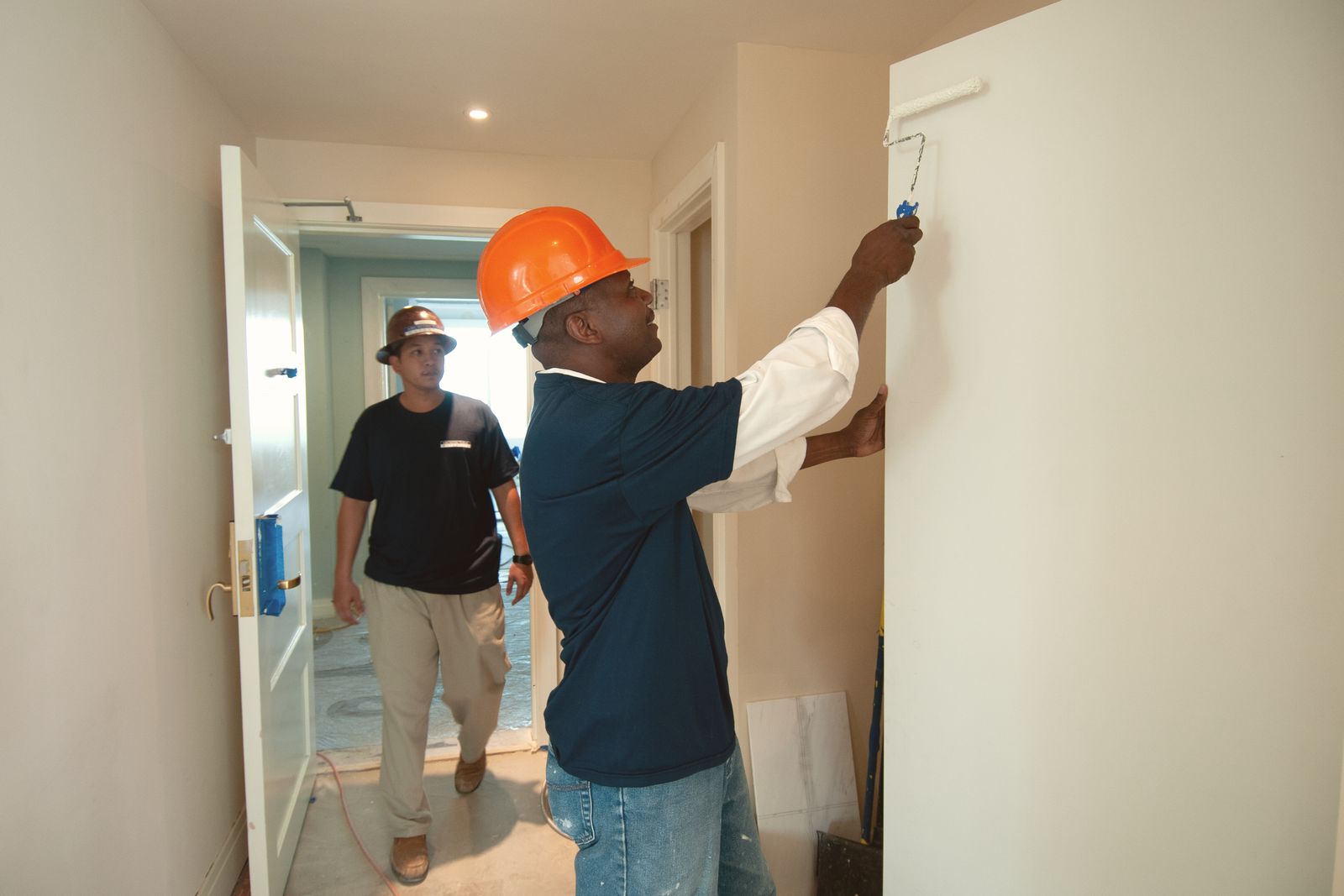
What this work really involves
Painting is the trade everyone thinks they understand and the one that most visibly reveals what happened underneath. A wall that was not skim coated, a corner bead that was not set, a nail pop that was not fixed, all of it shows up in the second coat under raking light.
Our painters come after the drywall is finished to a defined level, the trim is installed and caulked, and the site has been vacuumed. On any house built before 1978 we work under lead-safe renovation practices, including containment and HEPA cleanup.
Permit path
No permit; lead-safe practices required by federal rule on houses built before 1978
What is included
- 01
Surface preparation
Nail pops set and patched, seams checked under raking light, corner beads verified, sanding between coats.
- 02
Trim and caulk
Every inside corner and trim-to-wall joint caulked, nail holes filled and sanded before priming.
- 03
Priming
Full prime on new drywall and on any patched surface, with a stain-blocking primer where tannin or smoke is present.
- 04
Sheen schedule
A documented sheen per surface: ceilings, walls, trim, doors, and wet rooms, so touch-ups match years later.
- 05
Lead-safe practice
On pre-1978 houses, containment, wet methods, HEPA vacuums and a cleaning verification at the end of each work area.
- 06
Leave-behind record
Colour, product, sheen and room list handed over at closeout, with labelled touch-up cans.
How the stages run
- 01
Colour review
Large samples painted on site and looked at in morning and evening light, not chosen from a chip.
- 02
Prep
Three to six days. Protection, patching, sanding, caulking.
- 03
Prime
One to two days.
- 04
Trim and doors
Three to six days, usually sprayed and back-rolled or brushed depending on the profile.
- 05
Walls and ceilings
Four to eight days for two coats on a whole level.
- 06
Touch-up
Ongoing through the punch list and after floor protection comes up.
What moves the price
- Wall condition
- A skim coat on a textured wall you want flat is a separate and significant line item.
- Trim quantity
- Doors, casing, base, crown and built-ins are priced by count and profile, not by floor area.
- Ceiling height
- Anything over nine feet adds staging time.
- Colour change
- A deep colour over white, or white over a deep colour, often needs a third coat.
- Occupied work
- Containment, daily cleanup and shorter working windows add labour.
Two things we will always tell you
Paint late. A room painted before floors, fixtures and glass go in will be touched up twice, and the second touch-up rarely matches perfectly on a flat sheen.
Keep a labelled touch-up can per room. We hand them over in the closeout binder.
Usually built alongside
Because flattening an existing textured wall is a plastering operation, not a painting one. We price it honestly rather than bury it.
We usually specify a washable matte on walls and a satin or semi-gloss on trim and doors. The full schedule is in the closeout binder.
Yes, with low-VOC products and ventilation. On pre-1978 houses we use lead-safe containment regardless of whether you plan to test.
We can scan a chip, but scanned matches drift. If the original product and code are known, that is always better.

Start with a walk-through, not a price
Ninety minutes in your house. We look at the crawlspace, the attic and the panel before we look at the kitchen, and you leave with a budget band you can plan around.